Why Do I Read Multiple Times to Understand
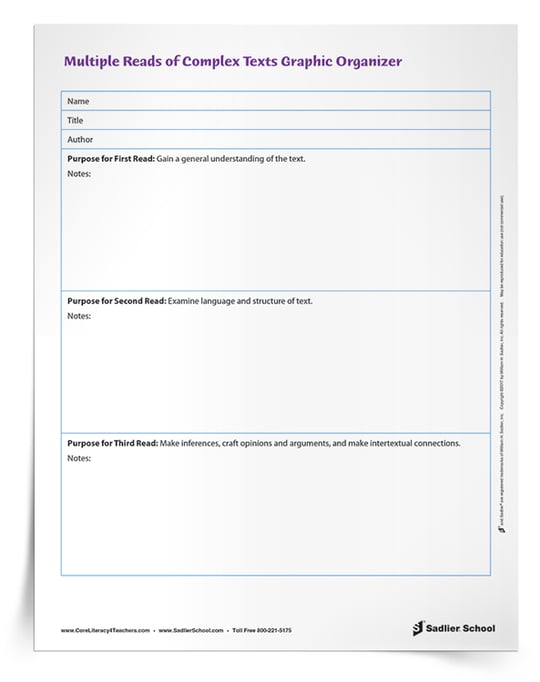
Having your students do multiple reads of a text (that is, re-reading more than closely with a specific purpose for each read) is an excellent style to deepen their understanding of the meaning of text! Download the Multiple Reads of Complex Texts Graphic Organizer now! Shut reading is when a reader reads a text multiple times in order to analyze its details so equally to make interpretations and develop a deep understanding of the text. It is looking closely at how an writer's ideas unfold through a text by examining the plot, vocabulary, syntax, structure, and/or betoken of view through multiple re-readings of a slice of literature information text. When I ask my colleagues why close reading is not used more frequently in their reading classes, I am normally given the post-obit ii reasons. REASON #i REASON #2 And here'southward my response... Offset, I concord that many districts take reading curricula in place that teachers cannot possibly consummate in 180 school days. Yet, this is why nosotros need to teach smart. If you requite your students do during the first one-half of the year with analyzing the details of a text by looking closely at the plot, vocabulary, syntax, construction, and betoken of view through multiple reads, you are setting them upwards to exist able to do this more than independently during the 2nd half of the schoolhouse year. With a focus on fostering close reading habits in the start of the year you are building strong readers that volition be able to interpret a text on a loftier level independently. Our goal should be to develop potent readers with strategies they volition be able to use throughout their lives to better empathise a text. In other words, nosotros should prioritize "depth over latitude." Not every text should be part of the close reading process. Text option is critical to successful close reading lessons. Selected texts should be short, complex, and of a variety of genre. Text option needs to be made advisedly and purposefully. Close reading lesson plans can be set up upwards in different formats. If you are familiar with this blog, you know I like to structure my shut reading lesson plans over a four-day menstruation. Close reading can exist very hard for elementary grade level students, so modeling and exercise is essential. I believe the best shut reading lessons plans utilize a scaffolded approach to instruction: In every close reading lesson plan that I write, I have the students read focusing on a specific lens. Recently, I read the book Turning the Page on Complex Texts: Differentiated Scaffolds for Close Reading Pedagogy by Diane Lapp, Barbara Moss, Maria C. Grant, and Kelly Johnson. Here is a cursory synopsis: Ensure all learners go successful close readers. In this powerful resource, the authors examine what features make a text circuitous. Larn how to select advisable complex texts and design teaching to run into the needs of every student. Explore form-specific classroom scenarios that illustrate how to scaffold lessons to foster close reading and deepen comprehension at all stages of One thousand–12 education. Benefits Proceeds practical pedagogy strategies for creating close reading lessons. Consider grade-level-specific instructional scenarios that illustrate how to support students' reading comprehension equally they larn to read closely. Acquire how to evaluate a text's complexity and how to ask text-dependent questions that can assist students empathize the deeper meaning of the text. Study evidence for why continuous assessment of student performance is vital for making sure all students larn to closely read complex texts. Discover potential contingency scaffolds for the classroom and how to apply them to promote student success in closely reading a text. In this book, the authors focus on 3 purposes for each multiple read. These three purposes ensure that students use each multiple read to assimilate and deepen their understanding of circuitous text. The three purposes of multiple reads are: PURPOSE FOR 1ST READ PURPOSE FOR 2nd READ PURPOSE FOR 3rd READ Since reading this book I've been using this new format for multiple reads in my classroom. To assistance my students I created a graphic organizer based on the three purposes for each read mentioned above. I use this organizer ii ways. First, I employ it to assist making my instructional plans. Second, I collect data and write observational notes on how students are understanding the text. The organizer is a dandy way for students to accept notes equally they complete each multiple read of a complex text. Download the Multiple Reads of Complex Text Graphic Organizer now. In the didactics field, there are always new ways to instruct students. This last summertime I researched different strategies for creating close reading lessons and constitute the volume, Turning the Page on Complex Texts: Differentiated Scaffolds for Close Reading Instruction by Diane Lapp, Barbara Moss, Maria Grant and Kelly Johnson, to exist an invaluable resources. By learning different approaches to shut reading instruction I am better equipped to aid my students closely read complex texts successfully. I've been following the arroyo established past these experts on shut reading to enhance multiple reads and ensure students read with a purpose!
MAKING THE Example FOR CLOSE READING IN EVERY CLASSROOM
There is barely enough time to get through the curriculum, and then there is certainly not enough time to be rereading textile.
Students practice not similar to reread a text. Sometimes information technology is a challenge only to get them to do the beginning reading. SETTING Upwardly CLOSE READING LESSON PLANS
WHAT THE EXPERTS SAY Nearly MULTIPLE READS OF A COMPLEX TEXT
Gaining a general understanding of the text.
Examine language and structure of text.
Make inferences, craft opinions and arguments, and make intertextual connections. GRAPHIC ORGANIZER FOR MULTIPLE READS OF A COMPLEX TEXT

IN SUMMARY
Source: https://www.sadlier.com/school/ela-blog/the-purposes-for-multiple-reads-in-close-reading-lessons
0 Response to "Why Do I Read Multiple Times to Understand"
Post a Comment