If I Read 15 Minutes a Week, How Much Will I Read in a Year
This is the 2d entry in the Teaching Leader's Guide to Reading Growth, a 7-role series well-nigh the human relationship betwixt reading do, reading growth, and overall student accomplishment.
In our last post, we examined how reading practice characteristics differ between persistently struggling students and students who start out struggling but stop up succeeding—and how strong reading skills are linked to loftier school graduation rates and higher enrollment rates.
However, it's non simply struggling readers who could benefit from more reading practice. A study of the reading practices of more than 9.ix million students over the 2015–2016 schoolhouse year establish that more half of the students read less than 15 minutes per mean solar day on average.1

Fewer than one in five students averaged a half-hour or more of reading per day, and fewer than i in three read between 15 and 29 minutes on a daily footing.

The problem is that 15 minutes seems to be the "magic number" at which students get-go seeing substantial positive gains in reading achievement, still less than half of our students are reading for that amount of fourth dimension.
xv minutes seems to exist the "magic number" at which students showtime seeing substantial positive gains in reading achievement; students who read only over a half-hour to an hour per day see the greatest gains of all.
An analysis comparison the engaged reading fourth dimension and reading scores of more than 2.two meg students establish that students who read less than five minutes per day saw the lowest levels of growth, well below the national average.2 Fifty-fifty students who read 5–fourteen minutes per day saw sluggish gains that were below the national average.
Just students who read 15 minutes or more than a mean solar day saw accelerated reading gains—that is, gains higher than the national average—and students who read but over a half-hour to an hr per twenty-four hours saw the greatest gains of all.
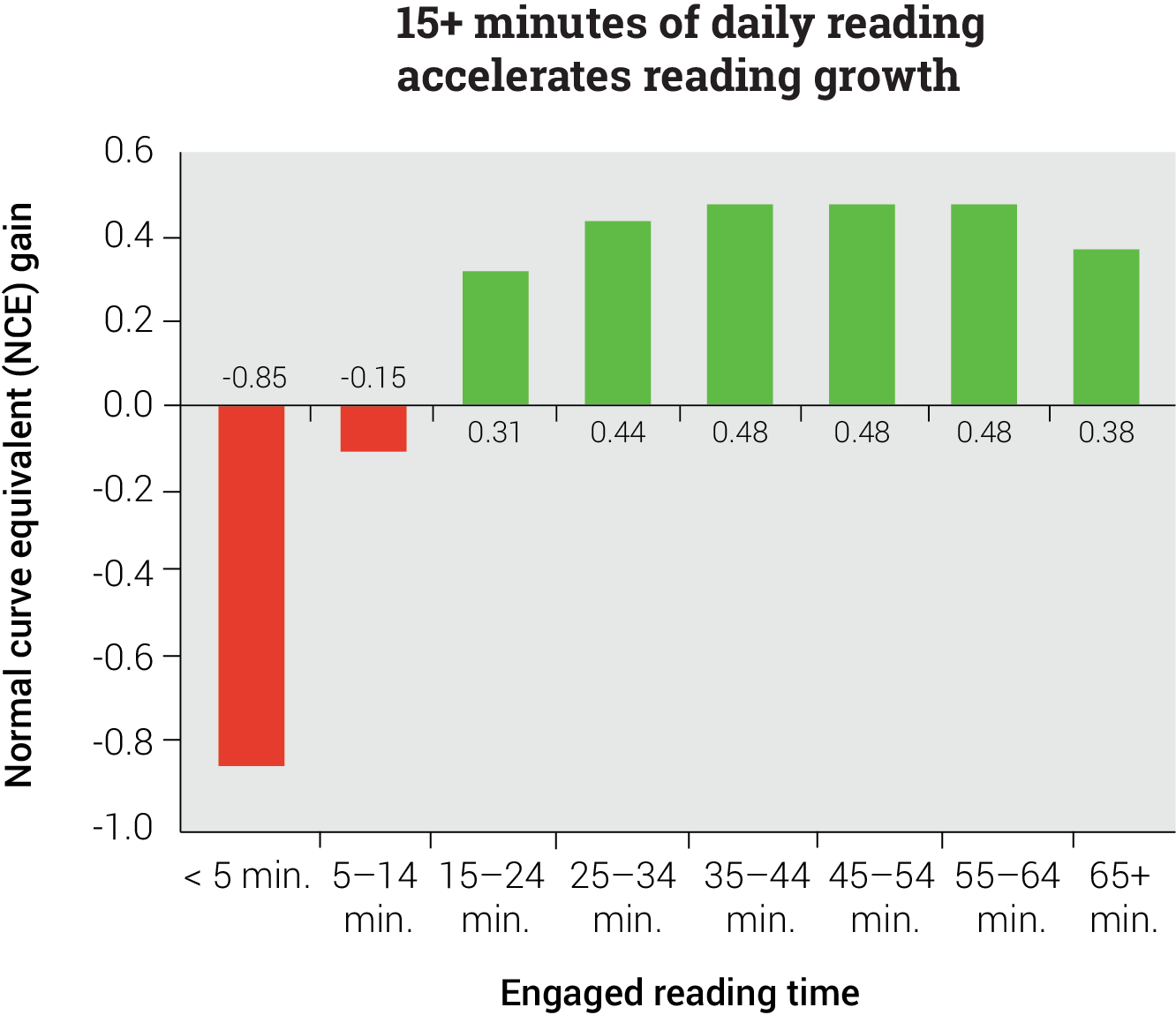
Although many other factors—such equally quality of instruction, equitable access to reading materials, and family background—also play a role in achievement, the consequent connection between time spent reading per day and reading growth cannot be ignored.
Moreover, if reading practice is linked to reading growth and accomplishment, and then it follows that depression levels of reading do should correlate to low levels of reading functioning and loftier levels of reading practice should connect to high levels of reading performance. This pattern is precisely what we see in pupil test data.
Strong connections between reading exercise and achievement
An analysis of more than 174,000 students' Programme for International Student Cess (PISA) scores revealed that connexion between reading engagement and reading functioning was "moderately potent and meaningful" in all 32 countries examined, including the United States.3 On average, students who spent more time reading, read more diverse texts, and saw reading as a valuable action scored college on the PISA'south combined reading literacy scale.
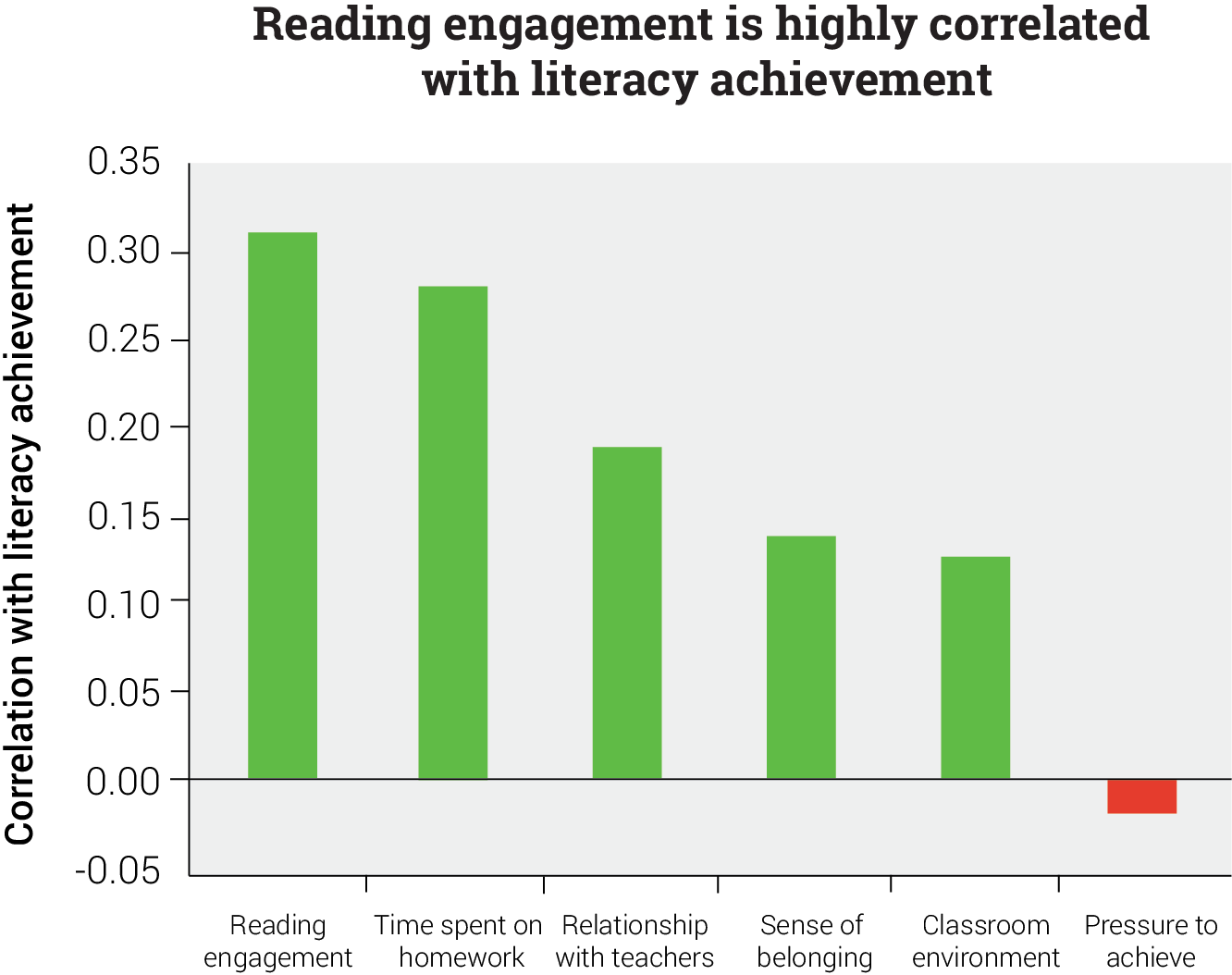
The study also found a student'due south level of reading engagement was more highly correlated with their reading achievement than their socioeconomic status, gender, family unit structure, or time spent on homework. In fact, students with the lowest socioeconomic background just loftier reading date scored better than students with the highest socioeconomic groundwork only low reading engagement.
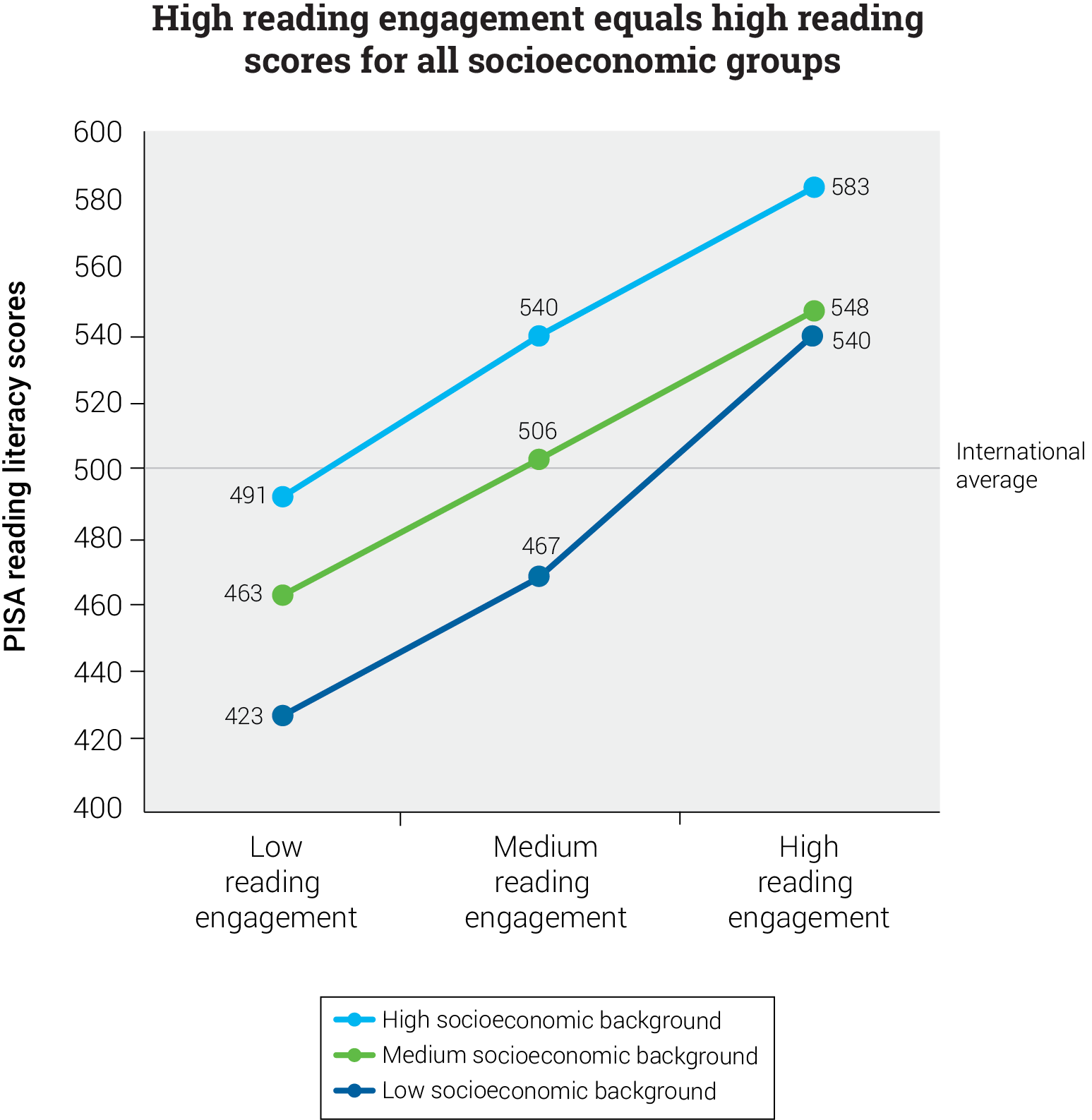
Overall, students with high reading engagement scored significantly above the international average on the combined reading literacy scale, regardless of their family background. The contrary was also truthful, with students with depression reading engagement scoring significantly below the international boilerplate, no matter their socioeconomic condition.
The authors suggested that reading practice tin can play an "important role" in closing accomplishment gaps between unlike socioeconomic groups. Frequent high-quality reading practice may help children recoup for—and fifty-fifty overcome—the challenges of being socially or economically disadvantaged, while a lack of reading practice may erase or potentially reverse the advantages of a more privileged background. In curt, reading practice matters for kids from all walks of life.
For students within the U.s., reading practice may not but exist more of import than socioeconomic condition—information technology may also be more of import than many school factors.
Looking at only American students' PISA scores, nosotros see that reading engagement had a college correlation with reading literacy achievement than fourth dimension spent on homework, relationships with teachers, a sense of belonging, classroom environment, or even pressure to accomplish (which had a negative correlation). In add-on, a regression analysis showed accomplishment went upward across all measures of reading literacy operation when reading appointment increased.
Although the PISA simply assesses fifteen-year-olds, similar patterns can be seen in both younger and older American students. In 2013, the National Center for Education Statistics (NCES) compared students' National Assessment of Educational Progress (NAEP) reading scores with their reading habits.iv For all age groups, they found a clear correlation between the frequency with which students read for fun and their average NAEP scores: The more frequently students read, the higher their scores were.
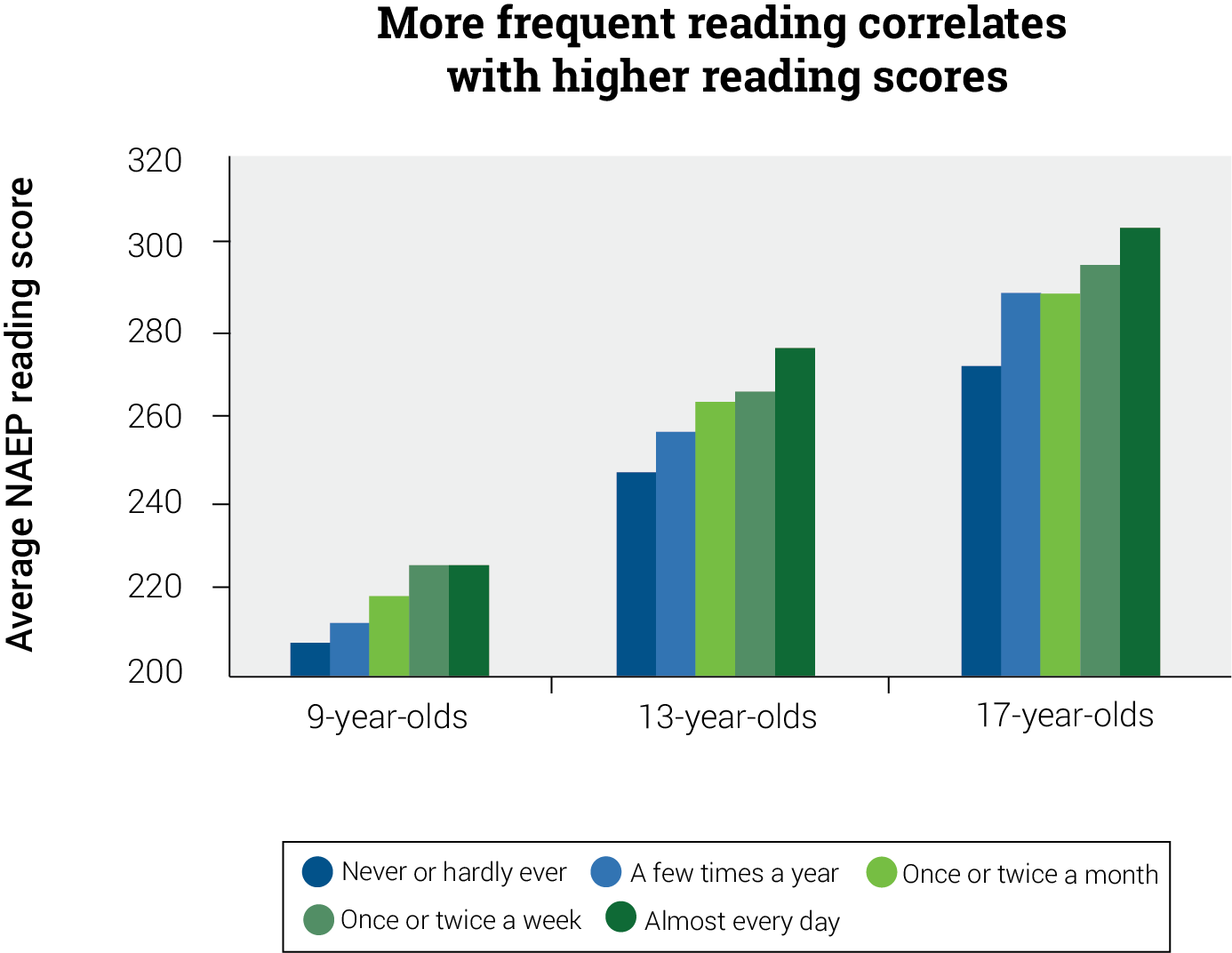
What is especially interesting almost the NAEP results is that the correlation between reading frequency and reading scores was truthful for all age groups and the score gaps increased beyond the years. Among ix-twelvemonth-olds, there was merely an 18-point departure between children who reported reading "never or hardly ever" and those who read "about every day." By age 13, the gap widened to 27 points. At age 17, it further increased to 30 points.
This seems to run contrary to the commonly held wisdom that reading do is well-nigh of import when children are learning how to read only less essential in one case fundamental reading skills have been caused. Indeed, we might even hypothesize the opposite—that reading practice may abound more important as students movement from grade to grade and encounter more challenging reading tasks. Until more than inquiry either confirms or disproves this possible caption, it is nothing more than than a guess, but an interesting one to consider nonetheless.
However, what is clear is that reading exercise is decreasing among all age groups, with the most dramatic decreases amid the very students who may need it the almost.
Troubling declines in reading practice
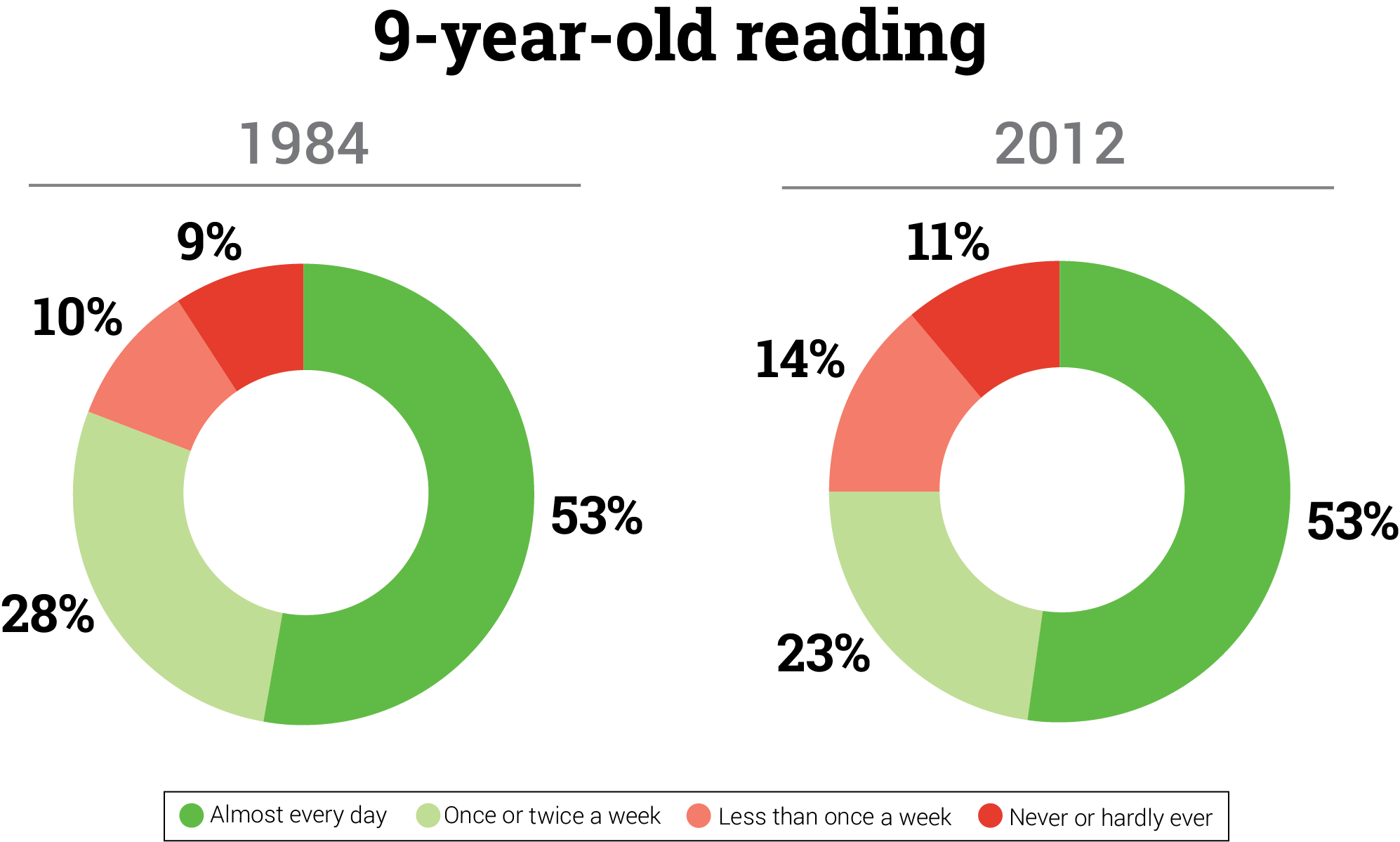
Over the last three decades, reading rates have dramatically declined in the United States. In 1984, NAEP results showed the vast majority of 9-year-olds read for fun once or more per week, with more half reporting reading about every day. Only one in five reported reading two or fewer times per calendar month. By 2012, 25% of all nine-year-olds were reading for pleasure fewer than 25 days per year.5
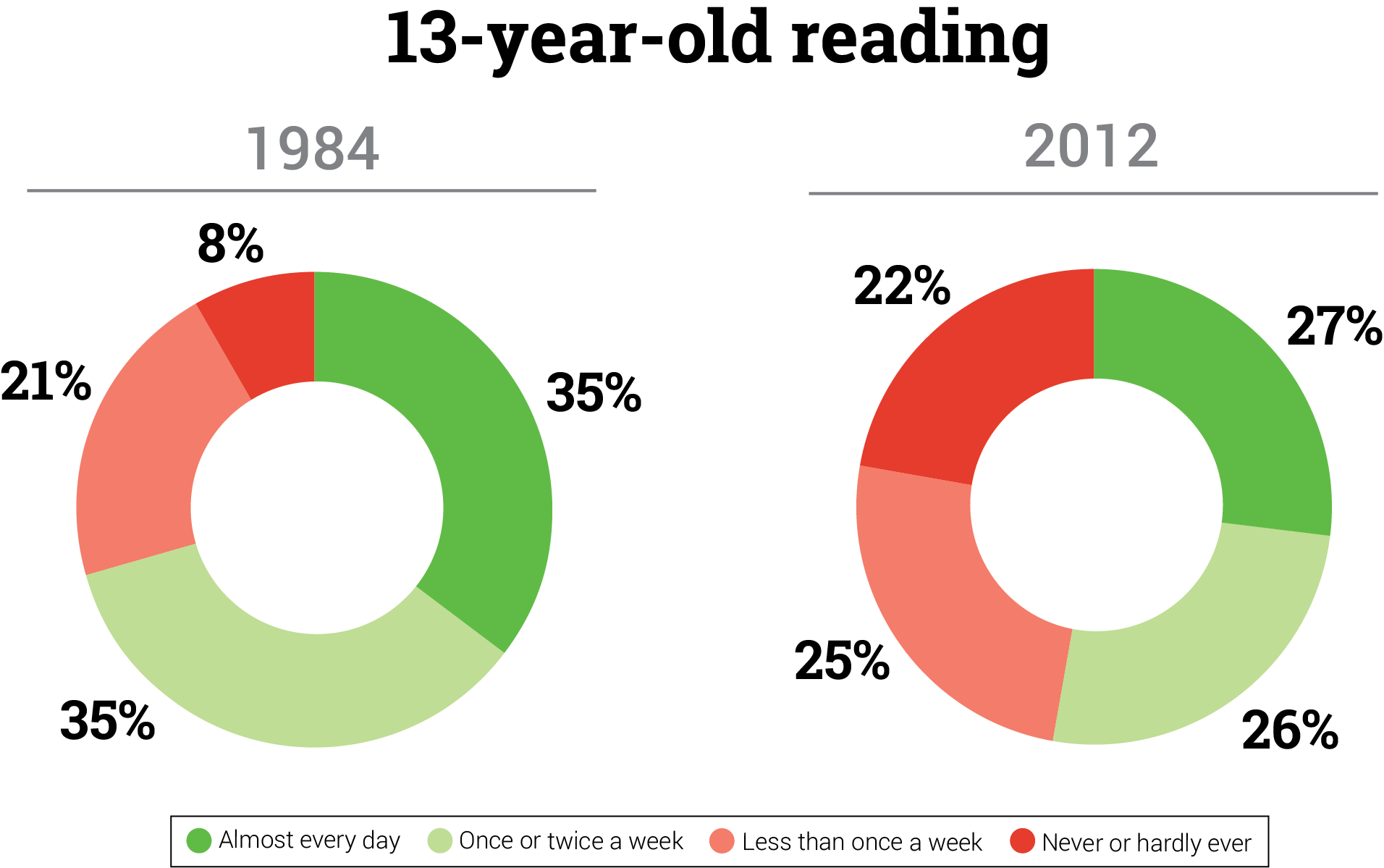
For older students, the drop is fifty-fifty more precipitous. In 1984, 35% of 13-twelvemonth-olds read for fun nearly every 24-hour interval, and another 35% read one or two times per week—in total, more than two-thirds of xiii-year-olds reported reading at to the lowest degree one time a week. In 2012, nearly half read less than once a week.
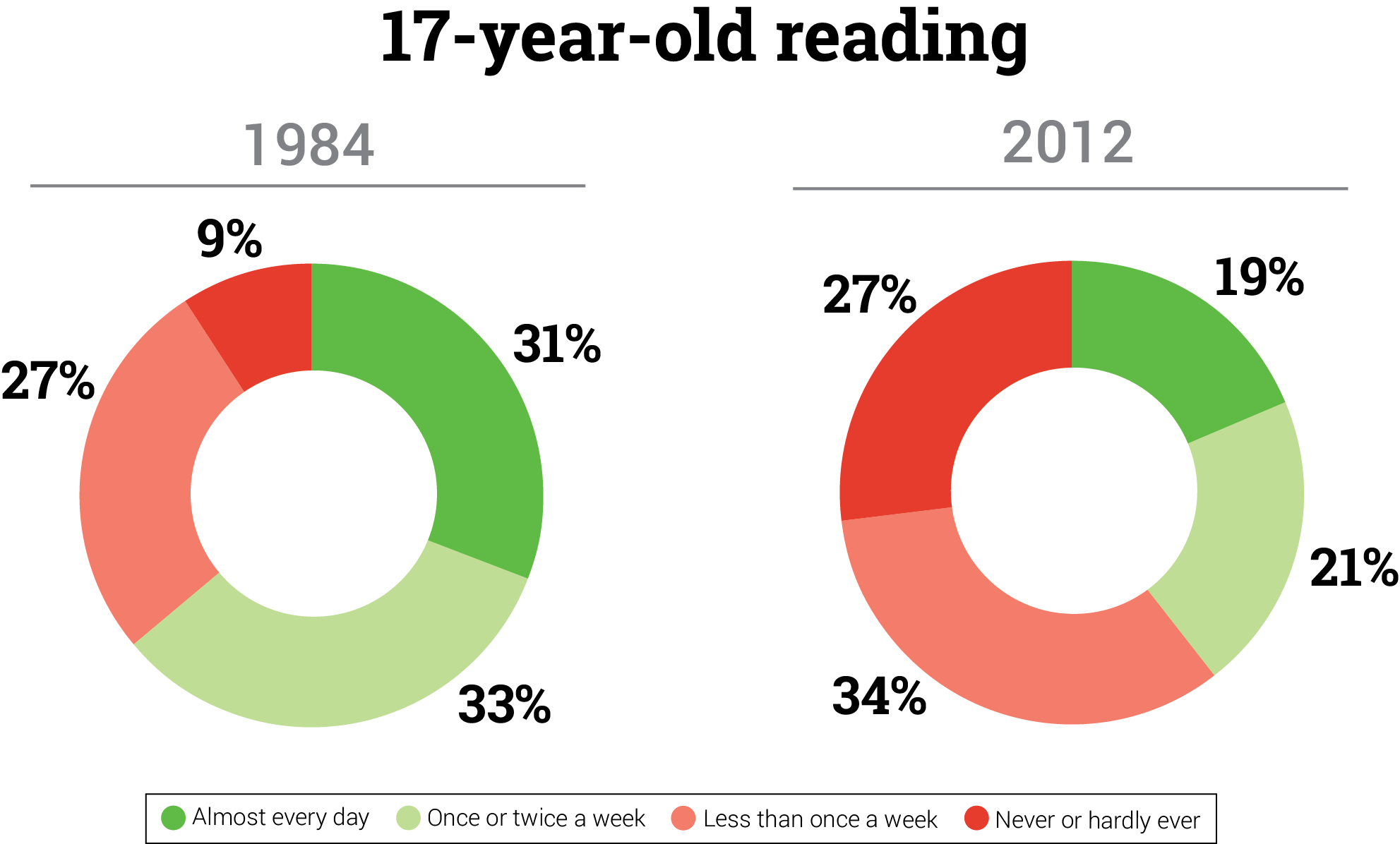
Among 17-year-olds, the percentage reading about every day dropped from 31% in 1984 to just 19% in 2012, while the percentage who read for fun less than once a calendar week rose from 36% to 61%. The number of 17-year-olds reporting reading "never or inappreciably ever" actually tripled.
And the turn down in reading is non due to students spending more fourth dimension on homework in 2012 than in 1984. During the same time menstruation, the percent of students who reported spending more than an hr on homework actually declined.
In 1984, 19% of 9-twelvemonth-olds, 38% of thirteen-year-olds, and 40% of 17-year-olds reported spending an 60 minutes or more than on homework the day prior to the NAEP. In 2012, those numbers had dropped to 17% for 9-year-olds, xxx% for 13-yr-olds, and 36% for 17-year-olds.
Why are nosotros seeing the greatest gaps and the greatest declines in the oldest students? Although many unlike factors are probable at play, one of them might be that the effects of reading practice are cumulative over a educatee's schooling, especially when it comes to vocabulary.
The long-term effects of reading practice
What's the deviation between kids who read more than thirty minutes per 24-hour interval and those who read less than 15 minutes per solar day?
Twelve million.
Between kindergarten and 12th class, students with an average daily reading time of thirty+ minutes are projected to meet 13.7 million words. At graduation, their peers who averaged less than xv minutes of reading per twenty-four hour period are probable to be exposed to only i.five one thousand thousand words. The departure is more than 12 million words. Children in between, who read fifteen–29 minutes per day, will encounter an average of 5.7 million words—less than one-half of the high-reading grouping but nearly four times that of the low-reading group.1
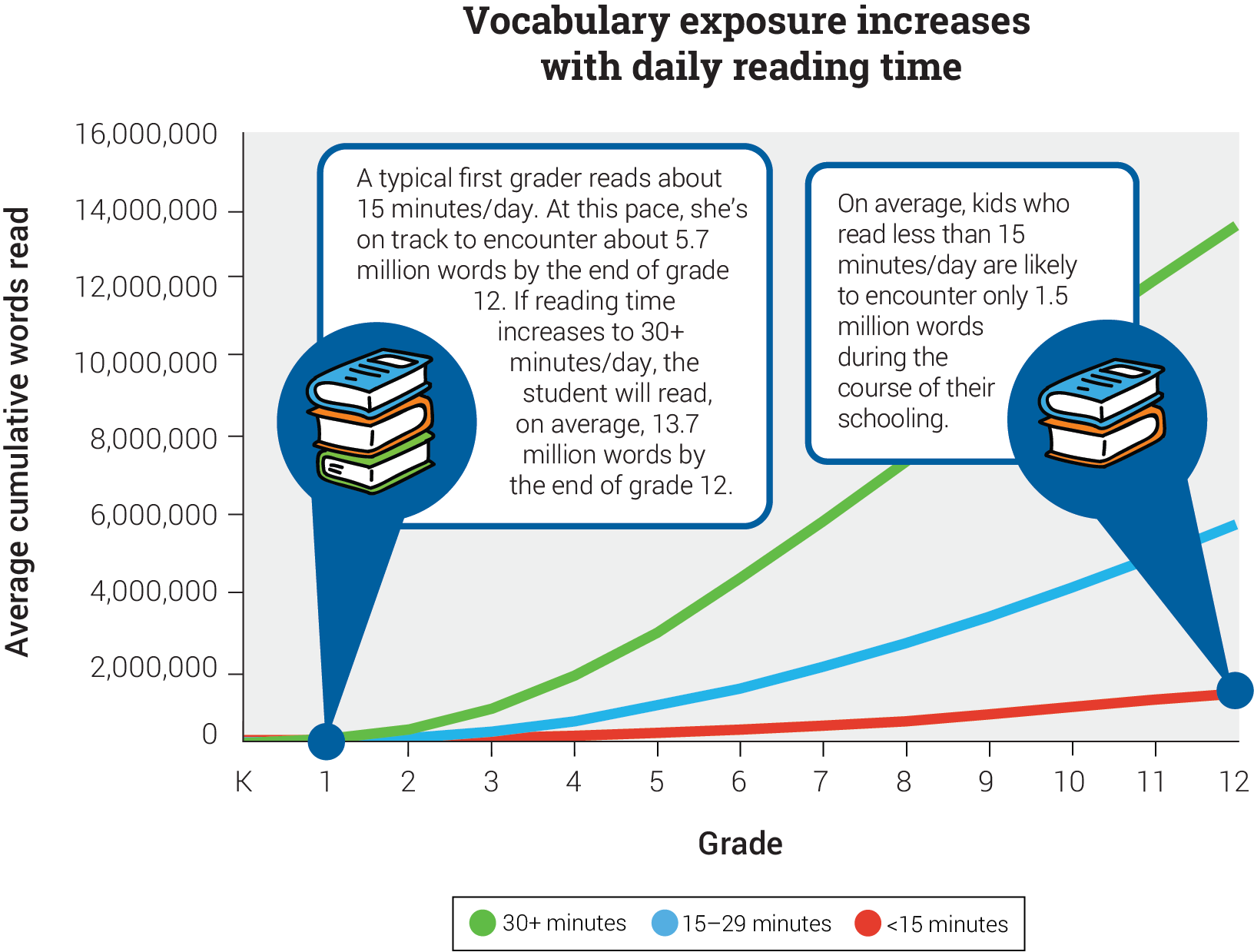
Some researchers estimate students learn ane new word of vocabulary for every thousand words read.half dozen Using this ratio, a pupil who reads only one.5 1000000 words would acquire simply i,500 new vocabulary words from reading, while a student who reads thirteen.vii million words would learn xiii,700 new vocabulary terms—more than nine times the amount of vocabulary growth.
This is particularly of import when nosotros consider that students can acquire far more words from reading than from direct instruction: Fifty-fifty an aggressive schedule of 20 new words taught each calendar week will result in only 520 new words past the end of the typical 36-week school year. This does non hateful that reading do is "better" than direct instruction for building vocabulary—direction instruction is key, but teachers tin but do and then much of it. Instead, we ask educators to imagine the potential for vocabulary growth if direct instruction, structural analysis strategies, and reading practise are all used to reinforce ane another.
Vocabulary plays a critical role in reading achievement. Research has shown that more one-half the variance in students' reading comprehension scores tin be explained by the depth and latitude of their vocabulary knowledge—and these two vocabulary factors can even be used to predict a student'due south reading performance.seven
We tin see the human relationship between vocabulary and reading achievement conspicuously in NAEP scores, where the students who had the highest boilerplate vocabulary scores were the students performing in the top quarter (in a higher place the 75th percentile) of reading comprehension. Similarly, students with the everyman vocabulary scores were those who were in the lesser quarter (at or below the 25th percentile) in reading comprehension.8 This ways those additional 12 1000000 words could potentially have a huge affect on student success.
Then what are we to do, when reading practice is so clearly connected to both vocabulary exposure and reading achievement, but non enough students are getting enough reading practice to bulldoze substantial growth?
The answer seems clear. Nosotros demand to make increasing reading practice a top priority for all students in all schools. Making reading practice a organisation-wide objective may be one of the almost important things nosotros can practice for our students' long-term outcomes, particularly when we combine it with loftier-quality teaching and constructive reading curricula. It is time to put as much focus on reading do as we practice on school civilization, educatee-educator relationships, and socioeconomic factors.
Nonetheless, non all reading practise is built the same. Quantity matters, but then does quality. In the adjacent post in this series, we explore how you tin can ensure your students are getting the nearly out of every minute of reading practice.
To read the next post in this series, click the imprint beneath.

References
1 Renaissance Learning. (2016). What kids are reading: And how they grow. Wisconsin Rapids, WI: Writer.
ii Renaissance Learning. (2015). The research foundation for Accelerated Reader 360. Wisconsin Rapids, WI: Author.
3 Kirsch, I., de Jong, J., Lafontaine, D., McQueen, J., Mendelovits, J., & Monseur, C. (2002). Reading for change: Performance and engagement beyond countries: Results from PISA 2000. Paris, France: System for Economic Co-operation and Development (OECD).
4 National Middle for Education Statistics. (2013). The nation'south study card: Trends in bookish progress 2012 (NCES 2013 456). Washington, DC: U.Southward. Department of Teaching Constitute of Education Sciences.
5 National Center for Education Statistics. (2013). Tabular array 221.30: Average National Assessment of Educational Progress (NAEP) reading calibration score and pct distribution of students, by historic period, amount of reading for schoolhouse and for fun, and fourth dimension spent on homework and watching TV/video: Selected years, 1984 through 2012. Digest of Education Statistics. Washington, DC: U.Due south. Department of Didactics Plant of Education Sciences. Retrieved from: https://nces.ed.gov/programs/digest/d15/tables/dt15_221.30.asp
vi Bricklayer, J.M., Stahl, S. A. , Au, K. H. , & Herman, P. A. (2003). Reading: Children's developing noesis of words. In J. Overflowing, D. Lapp, J. R. Squire, & J. M. Jensen (Eds.), Handbook of research on pedagogy the English language arts (2nd ed., pp. 914-930). Mahwah, NJ: Lawrence Erlbaum Associates.
7 Qian, D. D. (2002). Investigating the Relationship Between Vocabulary Noesis and Academic Reading Performance: An Assessment Perspective. Language Learning, 52(3), 513-536.
eight National Center for Educational activity Statistics. (2013). 2013 Vocabulary report. 2013 Reading cess. Washington, DC: U.S. Department of Pedagogy Institute of Educational activity Sciences.
Source: https://www.renaissance.com/2018/01/23/blog-magic-15-minutes-reading-practice-reading-growth/
0 Response to "If I Read 15 Minutes a Week, How Much Will I Read in a Year"
Post a Comment